Contrast Therapy: The Complete Protocol for Sauna + Cold Plunge
Master the art of alternating heat and cold for maximum recovery, mental clarity, and resilience. Complete protocols from beginner to advanced.
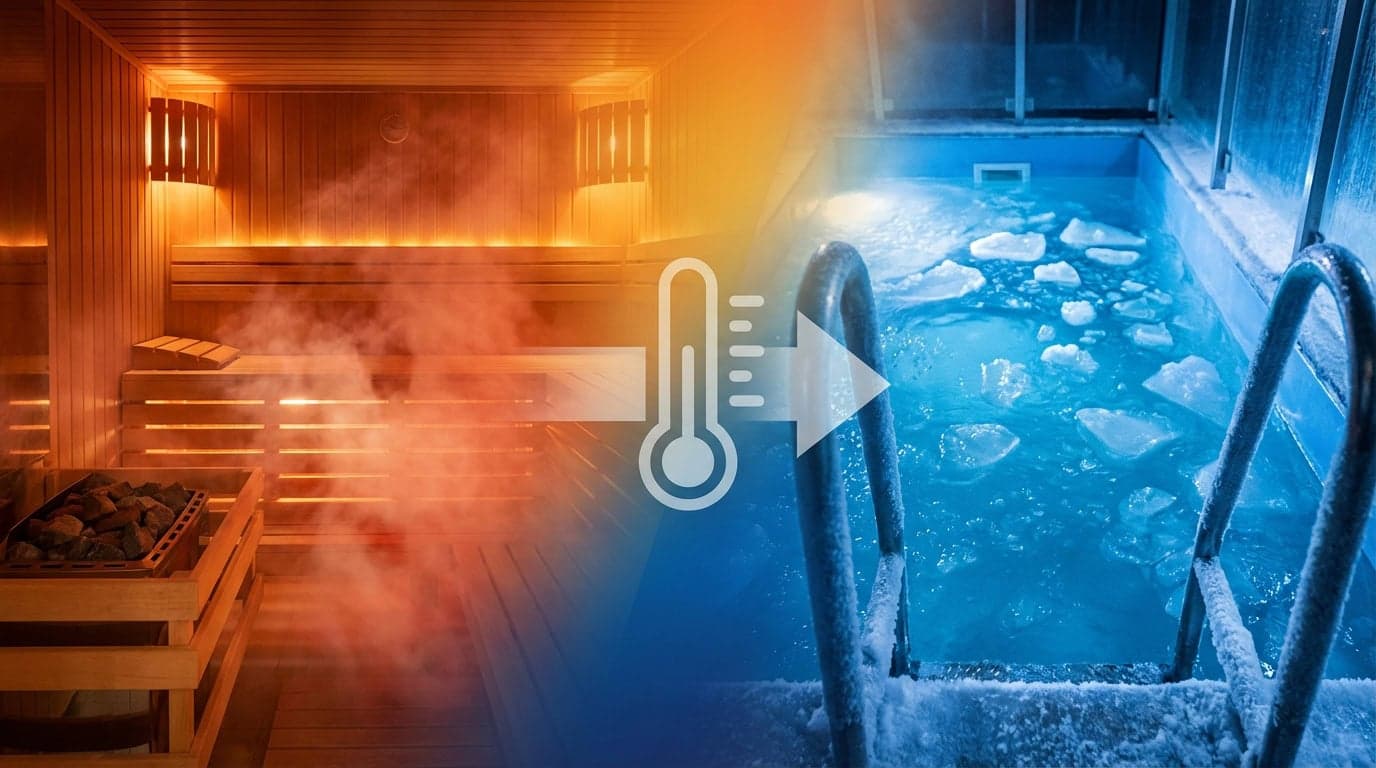
Contrast Therapy: The Complete Protocol for Sauna + Cold Plunge
You have probably heard someone on a podcast rave about jumping from a 180-degree sauna into ice-cold water. Maybe it sounded insane. Maybe it sounded exactly like the kind of controlled suffering you have been looking for.
Good news: the science backs it up. Contrast therapy is not just biohacker theater. It is one of the most potent tools available for recovery, mental clarity, and building resilience. And yes, it will be uncomfortable. That is the point.
TL;DR - The Beginner Protocol:
- 10 minutes in the sauna (160-180F)
- 30-60 seconds cold exposure (50-60F)
- Repeat 2 times
- Always end on cold
- Total time: 25-30 minutes
What Is Contrast Therapy?
Contrast therapy is the deliberate alternation between heat exposure (sauna) and cold exposure (cold plunge, ice bath, or cold shower). The practice has roots going back centuries in Nordic countries, Russia, and Japan, but modern science is finally catching up to what these cultures understood intuitively.
Here is the key insight: combining both is more powerful than either alone.
A 2017 study found that alternating between hot saunas and cold plunges helped team sport athletes recover from fatigue within 24-48 hours of intense activity. Critically, using cold immersion alone did not reproduce these results. The magic happens in the contrast.
When you heat your body, blood vessels dilate (vasodilation). Blood flows to your extremities and skin surface. Then you hit the cold, and everything reverses. Vessels constrict (vasoconstriction), driving blood back to your core and vital organs.
This pumping action creates what researchers call a "vascular workout." You are essentially strength training your circulatory system.
The Hormetic Stress Response
Contrast therapy works through hormesis, the biological principle that low doses of stressors can trigger beneficial adaptive responses. Think of it as a controlled challenge that tells your body: "Adapt or die." Your body chooses to adapt.
Each cycle of heat and cold is a signal to your cells to get stronger, more efficient, more resilient. The temporary discomfort creates lasting improvements.
The Science: What Happens in Your Body
Let us get specific about the physiological cascade you are triggering.
Norepinephrine: The Focus Molecule
Cold exposure causes a massive spike in norepinephrine (noradrenaline), a neurotransmitter that enhances focus, attention, and mood. Research published in the European Journal of Applied Physiology found that cold water immersion at 14 degrees Celsius (57F) increased norepinephrine by an astounding 530%.
This is not a subtle effect. This is a pharmacological-level intervention achieved through nothing but temperature.
Dopamine: The Long-Lasting Mood Boost
Here is where it gets interesting. Unlike stimulants that spike dopamine quickly and crash it just as fast, cold exposure produces a sustained elevation in dopamine that can last for hours.
The same study showed plasma dopamine concentrations increasing by 250% following cold immersion. Dr. Andrew Huberman has highlighted this finding extensively, noting that this prolonged dopamine release is rare among natural interventions.
The result? Enhanced mood, motivation, and that hard-to-describe sense that everything is slightly more interesting and achievable.
Heat Shock Proteins and Cellular Repair
The sauna side of the equation triggers heat shock proteins (HSPs), which act as cellular maintenance crews. Frequent sauna sessions can increase HSP production by up to 48%, supporting:
- Cellular repair and protein folding
- Immune function
- Muscle recovery
- Longevity pathways
Inflammation Reduction
The cyclical vasodilation and vasoconstriction creates a pumping mechanism that helps flush metabolic waste and reduce inflammation. A systematic review analyzing 18 trials found that contrast therapy significantly reduced muscle soreness at every follow-up point from 6 to 96 hours post-exercise.
Cardiovascular Benefits
Regular contrast therapy has been shown to:
- Improve vascular tone and elasticity
- Regulate blood pressure
- Increase heart rate variability (a key marker of cardiovascular health)
- Reduce risk factors for heart disease
A 2018 study in the Journal of Human Hypertension found that regular sauna use lowered blood pressure in adults with hypertension.
Choose Your Protocol
The right protocol depends on your experience level and goals. Start conservative. You can always progress.
Beginner Protocol
For: First-timers and those building heat/cold tolerance
| Phase | Duration | Temperature |
|---|---|---|
| Sauna | 10 minutes | 160-170F (70-77C) |
| Cold | 30-60 seconds | 50-60F (10-15C) |
| Rounds | 2 cycles | - |
| End on | Cold | - |
Total session time: 25-30 minutes
Notes: A cold shower works perfectly fine here. You do not need a dedicated cold plunge to start. Focus on controlled breathing and staying calm.
Intermediate Protocol
For: Those with 4+ weeks of consistent practice
| Phase | Duration | Temperature |
|---|---|---|
| Sauna | 15 minutes | 170-180F (77-82C) |
| Cold | 1-2 minutes | 45-55F (7-13C) |
| Rounds | 3 cycles | - |
| End on | Cold | - |
Total session time: 50-60 minutes
Notes: At this level, you should be able to control your breath from the first second of cold exposure. If you are gasping, the water is too cold for your current adaptation level.
Advanced Protocol
For: Experienced practitioners with 3+ months of consistent practice
| Phase | Duration | Temperature |
|---|---|---|
| Sauna | 20 minutes | 180-200F (82-93C) |
| Cold | 2-3 minutes | 38-45F (3-7C) |
| Rounds | 3-4 cycles | - |
| End on | Cold | - |
Total session time: 75-90 minutes
Notes: At advanced levels, some practitioners incorporate breath holds or movement in the cold to break up the thermal layer (more on this below).
The Huberman Approach
Dr. Andrew Huberman recommends accumulating 11 minutes of cold exposure per week, spread across 2-4 sessions of 1-5 minutes each. For the sauna component, he suggests building toward 1 hour per week total.
His protocol emphasizes:
- Early in the day (cold raises body temperature afterward, which can disrupt sleep)
- Temperature cold enough to make you want to get out but safe to stay in
- Movement in the cold water to break the thermal layer
- Do not decide to extend time while already immersed (the dopamine rush can impair judgment)
Your First Session: Step-by-Step Guide
Ready to try it? Here is exactly how to execute your first contrast therapy session.
Before You Start
- Hydrate well - Drink 16-20 oz of water in the hours before
- Eat light - Not fasted, but no heavy meals within 2 hours
- Set your timer - Do not rely on "feel" for your first sessions
- Have a plan - Know your temperatures and durations before starting
The Session
Round 1:
- Enter the sauna. Sit or lie down. Breathe normally.
- Let yourself fully warm. You should be sweating by minute 5-7.
- At your target time, exit calmly. No rushing.
- Approach the cold. Take 3 deep breaths.
- Enter the cold deliberately. Exhale slowly as you submerge.
- Focus on slow, controlled exhales. This is your only job.
- Exit at your target time. Do not rush to warm up.
Round 2:
- Return to the sauna. Notice how different it feels.
- Your heat tolerance may feel improved. This is normal.
- Complete the round. Exit. Breathe.
- Second cold immersion. Same protocol.
- This round often feels more manageable. The contrast is working.
Cool Down:
- After your final cold exposure, let your body rewarm naturally
- Do not jump in a hot shower. Let brown fat activation do its work.
- Move gently. Walk around. Let circulation normalize.
- Dress in layers. You may oscillate between warm and cold for 30-60 minutes.
What If You Do Not Have a Cold Plunge?
No problem. Here are alternatives in order of effectiveness:
- Cold shower - Turn it to the coldest setting. Works well for beginners.
- Ice bath - A bathtub with 20-40 lbs of ice. DIY but effective.
- Cold outdoor body of water - Lake, ocean, river. Check temperatures and safety.
- Cold face immersion - Fill a bowl with ice water, submerge your face for 15-30 seconds. Triggers the dive reflex and still provides significant benefits.
For the face immersion hack: this activates the mammalian dive reflex, which produces many of the same autonomic nervous system effects as full-body immersion. It is a great entry point if full cold exposure feels too intense.
Mistakes to Avoid
Learn from others' errors so you do not have to make them yourself.
Going Too Cold Too Fast
The goal is cold enough to trigger adaptation, not so cold you cannot breathe or function. If you are hyperventilating and cannot control it after 30 seconds, the water is too cold for your current level.
Start at 55-60F (13-15C) and progressively lower over weeks. There is no glory in hypothermia.
Not Getting Hot Enough First
The contrast is what works. If you are lukewarm going into the cold, you are missing the point. You should be genuinely hot and sweating before transitioning.
Minimum sauna temperature: 160F (70C). Ideally higher once you are adapted.
Doing It Too Close to Bedtime
Both heat and cold exposure (paradoxically) raise core body temperature afterward. Your body heats up after cold exposure as a rebound effect. This is great for metabolism and brown fat activation. It is terrible for sleep.
Finish your session at least 2-3 hours before bed. Morning or early afternoon is ideal.
Skipping the Rewarming Period
After your final cold exposure, do not immediately jump in a hot shower or sauna. The natural rewarming process activates brown adipose tissue and extends the metabolic benefits.
Let yourself shiver. That shivering is your body generating heat and burning calories through brown fat activation.
Staying Too Still in the Cold
Here is a counterintuitive tip from Huberman: move your limbs in the cold water.
When you stay still, a thermal layer forms around your body that insulates you from the full cold stimulus. Moving your arms and legs breaks this layer and intensifies the exposure. You will feel significantly colder, but you will get more benefit from less time.
Recovery and Performance: When to Use (and When Not To)
Contrast therapy is a tool. Like any tool, context determines whether it helps or hinders.
Ideal Use Cases
- 48+ hours before competition - Full protocol for recovery and mental preparation
- After endurance training - Same day is fine, can enhance recovery
- After skill-based training - The mental clarity benefits can enhance learning
- Morning routine - Sets up dopamine and norepinephrine for the day
- Stress management - Excellent for building stress resilience
When to Avoid or Modify
Post-strength training (within 4-6 hours):
If your goal is muscle hypertrophy (growth), avoid cold exposure immediately after lifting. The cold can blunt the inflammatory response that signals muscle adaptation. Research suggests waiting at least 4-6 hours, or doing your contrast therapy on rest days.
Heat alone (sauna without cold) does not have this limitation and may actually enhance recovery from strength training.
If you have cardiovascular conditions:
The rapid shifts in blood pressure and heart rate can stress the cardiovascular system. If you have heart disease, uncontrolled hypertension, or a history of stroke, consult your physician before starting. Start with milder temperatures and shorter durations.
When sleep-deprived:
Contrast therapy is a stressor. If you are running on empty, adding another stressor may not serve you. Prioritize sleep first.
Mental Performance Benefits
Beyond physical recovery, contrast therapy builds mental resilience. Each session is practice in:
- Remaining calm under acute stress
- Controlling breath when the body wants to panic
- Making clear decisions in uncomfortable situations
- Delayed gratification (the suffering now, the benefits later)
Many practitioners report that the mental benefits exceed the physical ones. The confidence that comes from voluntarily doing hard things transfers to every other domain.
Frequently Asked Questions
How often should I do contrast therapy?
Start with 2 sessions per week. As you adapt, you can increase to 3-4 sessions weekly. Research suggests 2-4 sessions per week provides optimal benefit without overstressing the body.
Can I do this every day?
You can, but there is a point of diminishing returns. Your body needs recovery time to adapt. Daily contrast therapy is probably unnecessary unless you are a professional athlete with significant recovery demands.
Should I always end on cold?
For most goals, yes. Ending on cold extends the norepinephrine and dopamine elevation and allows for natural rewarming (brown fat activation). Some practitioners end on heat for relaxation purposes, but you sacrifice some metabolic benefits.
What should I eat or drink after?
Rehydrate immediately. Electrolytes are helpful if you sweated significantly. A balanced meal 30-60 minutes after is fine. Some practitioners prefer to extend the fasted state to maximize brown fat activation.
Is this safe for everyone?
Contrast therapy is generally safe for healthy adults. However, pregnant women, people with cardiovascular conditions, those with Raynaud's disease, and people with cold urticaria should consult a physician first. When in doubt, get medical clearance.
How long until I see benefits?
Acute benefits (mood, alertness, focus) occur immediately and last several hours. Adaptation benefits (improved cold tolerance, cardiovascular improvements) become noticeable after 2-4 weeks of consistent practice.
Final Thoughts
Contrast therapy is not about being tough. It is about being adaptable.
Every time you cycle between heat and cold, you are telling your body: environments change, and you need to be ready. Your cardiovascular system gets more flexible. Your nervous system gets more resilient. Your mind gets more comfortable with discomfort.
The research is solid. The practice is ancient. The benefits are real.
Start with the beginner protocol. Respect the process. And remember: the goal is sustainable practice, not a single heroic session that leaves you dreading the next one.
See you in the cold.
Want protocols like this delivered weekly? Join 10,000+ high performers who get our Thursday briefing with the latest research, actionable protocols, and equipment recommendations.
Subscribe to the Sauna Guide Newsletter - it takes 5 minutes to read and might change how you think about heat therapy forever.