How the World Sweats: A Journey Through Global Sauna Cultures
From Finnish saunas to Russian banyas, Japanese onsens to Korean jjimjilbangs. A cultural journey through humanity's love affair with heat.
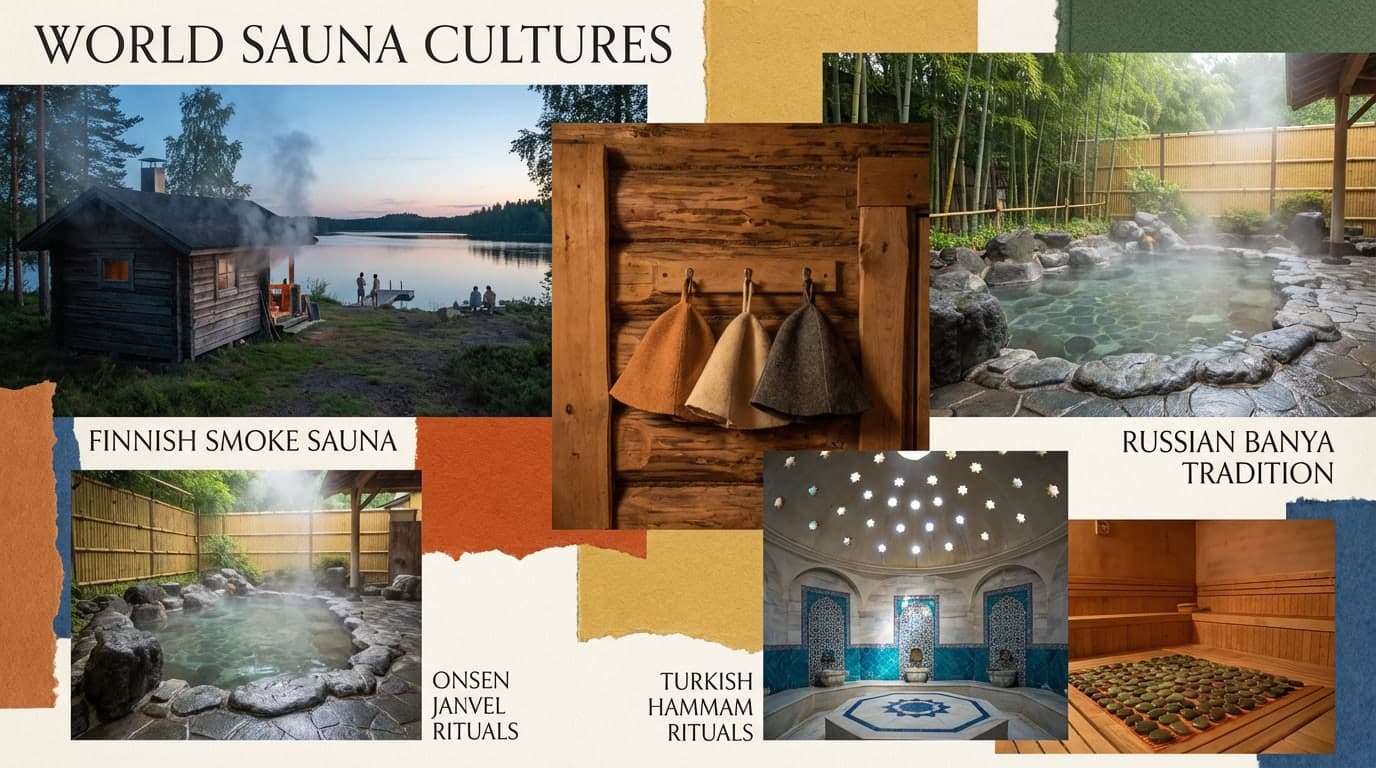
How the World Sweats: A Journey Through Global Sauna Cultures
There is something profoundly human about sitting in a hot room and sweating. We have been doing it for thousands of years, on every inhabited continent, in wildly different ways. And yet, despite our cultural differences, we have all arrived at the same essential conclusion: controlled heat does something magical to the body and soul.
I have spent years chasing heat around the globe. From a smoke-blackened Estonian hut where the walls themselves seemed to breathe history, to a neon-lit Korean jjimjilbang where strangers dozed in matching pajamas at 3 AM, to a German spa where an Aufgussmeister in Lederhosen waved a towel with the precision of a symphony conductor. Each culture has taken the basic concept of "make room hot, sit in room" and transformed it into something uniquely their own.
This is a guide to how the world sweats. Consider it part travel guide, part cultural anthropology, and part appreciation letter to humanity's 10,000-year experiment with therapeutic heat.
Finland: The Motherland of Sauna
Let us start where the word itself comes from. "Sauna" is one of the only Finnish words to enter the global vocabulary, and for good reason. Finland does not just have saunas; Finland is saunas.
The numbers are almost absurd: 3.3 million saunas for 5.6 million people. That is roughly one sauna for every 1.7 humans. More saunas than cars. Saunas in parliament buildings, in corporate offices, in apartment blocks, in summer cottages, in Burger Kings (I am not making this up).
The Sacred Space
For Finns, the sauna is not a luxury or a wellness trend. It is a space where the rules of ordinary life do not apply. Historically, it was the cleanest room in the house, the place where women gave birth and the dead were washed before burial. It was where you processed grief, made business deals, and proposed marriage.
The concept of "saunarauha" (sauna peace) is taken seriously. Inside the sauna, there are no titles, no hierarchies, no status symbols. A CEO and a janitor sit side by side, equally naked, equally human. This egalitarian spirit is central to Finnish identity.
The Rituals
The heart of Finnish sauna culture is "loyly" (pronounced LOO-lu), the steam that rises when water is ladled onto hot stones. Good loyly should feel like a gentle embrace, not an assault. The person nearest the stones typically controls the water, and there is a quiet etiquette about when and how much to add.
Then there is the "vihta" (or "vasta" in eastern Finland), a bundle of fresh birch branches used to gently beat the skin. This releases aromatic oils, improves circulation, and sounds stranger than it is. Once you try it, you understand. The scent of birch and the soft percussion on skin is oddly meditative.
The cycle matters: heat, then cold. Finns jump into lakes, roll in snow, or simply step into the winter air. This is not machismo; it is the point. The contrast between extreme heat and cold is what creates the particular euphoria Finns call "saunanjalkeiset," the peaceful, slightly floaty feeling after a proper sauna session.
Traveler's Tips for Finland
- Expect nudity. Swimsuits are considered unhygienic. Separate saunas for men and women make this comfortable.
- Saturday is traditional. The Saturday evening sauna is a national institution.
- Public saunas are thriving. Loyly in Helsinki offers a modern take with sea views. Tampere, the self-declared "sauna capital of the world," has the most public saunas per capita.
- Beer comes after, never during. The post-sauna beer is sacred. Drinking inside is not done.
Fascinating fact: In 2020, UNESCO added Finnish sauna culture to its list of Intangible Cultural Heritage of Humanity. It is officially recognized as a treasure of human civilization.
Russia: The Banya
Cross the border into Russia, and the sauna becomes something different entirely. The banya (pronounced BAN-ya) is louder, more social, more theatrical. If the Finnish sauna is a meditation, the Russian banya is a communal performance.
The Difference
The basic setup is similar: a hot room, water on stones, birch branches. But the energy is transformed. Banya culture is gregarious. Conversation flows. Laughter echoes. The temperature often climbs higher than Finnish saunas, exceeding 93 degrees Celsius (199 degrees Fahrenheit), and the atmosphere is one of shared intensity rather than solitary contemplation.
The felt hats are not a joke. At those temperatures, protecting your head from the heat is genuinely important. You will see grown men in nothing but a wool hat and a serious expression, and it is entirely sensible.
The Venik and Parenie
Where Finns use birch branches gently, Russians use them with vigor. The "venik" (bundle of branches, usually birch or oak) is soaked until supple, then wielded by a "banschik" (steam master) in a ritual called "parenie."
Parenie is an art form. The banschik captures the rising steam with the venik and directs it toward the body, alternating wafting motions with direct contact. It looks like someone being gently thrashed with a bouquet, and it feels surprisingly wonderful. The leaves release essential oils, the heat penetrates deeper, and the rhythm is almost hypnotic.
This is not a self-service situation. Traditionally, parenie is done by a skilled practitioner, and receiving a proper treatment from an experienced banschik is one of the great sensory experiences of Russian culture.
The Social Element
The banya has historically been a great equalizer in Russian society. Peasants and nobles bathed in the same banyas (though separately). Inside, formalities melted away. Business deals were struck. Friendships were sealed. Secrets were shared.
Today, banyas remain important social spaces. A banya outing with friends or colleagues is common, often followed by tea (or vodka, though the health-conscious banschiks frown on this).
Traveler's Tips for Russia
- Book a parenie. Do not just sit in the steam room. The venik treatment is the point.
- Bring a hat. Felt or wool hats protect your head from the intense heat.
- Embrace the cold contrast. Many banyas have plunge pools or, in winter, holes cut in nearby ice.
- Eat afterward. Post-banya feasts are traditional. You will be hungry.
Fascinating fact: Temperatures in Russian banyas often exceed what most Westerners consider survivable. The 2010 World Sauna Championship in Finland (discontinued after a contestant died) was won by Russians for years.
Germany and Austria: Aufguss Culture
Germany takes sauna culture and adds something unexpected: theater. The Aufguss ceremony is uniquely Germanic, a blend of wellness, performance, and rigorous efficiency that somehow captures the national character perfectly.
FKK: Free Body Culture
First, the nudity. German-speaking countries practice "Freikoorperkultur" (FKK), or free body culture. This means that in most German saunas, swimsuits are not just optional; they are prohibited. You will be asked to remove them.
This is not titillation. Germans view swimsuits as unhygienic (they trap bacteria and detergent chemicals) and philosophically problematic (they maintain artificial distinctions between bodies). The sauna is meant to strip away pretense. In a sauna, a banker sits beside a plumber, equally naked, equally human.
If this sounds intimidating, know that it becomes normal within minutes. Everyone is naked. No one is looking. After the initial adjustment, it is remarkably freeing.
The Aufguss Ceremony
The "Aufguss" (literally "pouring on") is where German sauna culture truly distinguishes itself. This is a scheduled event, announced by a bell, led by a trained "Aufgussmeister" (sauna master).
The Aufgussmeister enters the sauna with water, essential oils, and a large towel. They ladle infused water onto the stones, then use the towel to waft the hot air around the room in choreographed movements. The temperature spikes. The air fills with eucalyptus, citrus, or whatever today's theme might be. And then... the towel.
A skilled Aufgussmeister wields their towel like a conductor's baton. They create waves of heat that wash over bathers in controlled pulses. Some ceremonies are theatrical productions with music, costumes, and props. A "Bavarian Aufguss" might feature an Aufgussmeister in Lederhosen. A "Celtic Aufguss" might involve drinking horns. The creativity is endless.
These ceremonies last 10-15 minutes and should not be interrupted. If you miss the start, wait for the next one. The doors stay closed.
The Spa Complexes
Germany and Austria have turned sauna-going into an all-day experience. Therme Erding, near Munich, has been described as "the Disney World of German spas," with 28 themed saunas from around the world. Baden-Baden's historic bathhouses blend Roman ruins with Germanic precision. These are destination facilities, places to spend an entire day moving between saunas, steam rooms, pools, and rest areas.
Traveler's Tips for Germany/Austria
- Leave your inhibitions at the door. Nudity is mandatory in most saunas. Bring a towel to sit on.
- Catch an Aufguss. Check the schedule and plan around it. This is the highlight.
- Plan for a full day. German spa culture is leisurely. Rushing defeats the purpose.
- Mixed gender is normal. Men and women share saunas nude, and it is entirely matter-of-fact.
Fascinating fact: Professional Aufgussmeisters compete in international championships, judged on technique, creativity, and audience experience. It is a real career path.
South Korea: The Jjimjilbang
If Finnish saunas are meditation and Russian banyas are parties, Korean jjimjilbangs are something else entirely: theme parks for relaxation. Open 24 hours, sprawling across multiple floors, they are part spa, part social club, part budget hotel, and entirely unique.
More Than a Sauna
The jjimjilbang (pronounced JEEM-jil-bahng, meaning "heating room") emerged in the 1990s and quickly became central to Korean leisure culture. These are massive facilities with gender-separated wet areas (baths and shower rooms) and co-ed dry areas (various heated rooms, lounging areas, restaurants, entertainment).
The heated rooms are what make jjimjilbangs special. You might find a jade room (lined with jade stones, supposedly good for circulation), a salt room (walls of pink Himalayan salt), a charcoal room (for detoxification), an ice room (for contrast), and a bulgama (a superhot clay oven room, not for the faint-hearted). Each room has different temperatures and claimed benefits. Visitors wander between them, trying each for 10-15 minutes.
The Experience
Upon arrival, you pay an entrance fee (usually between $10-20), receive a locker key and a uniform: t-shirt and shorts in the facility's colors. You change, shower, and enter the world of the jjimjilbang.
The wet areas are nude and gender-separated. You scrub thoroughly at a shower station, soak in various temperature baths, and perhaps visit a Korean "seshin" for a vigorous exfoliating scrub. Then you dress in your uniform and head to the common areas.
Here, families lounge together. Friends gossip on heated floors. Couples share snacks from the restaurant. Strangers nap in rows on the warm ondol (heated floor). Some jjimjilbangs have karaoke rooms, arcades, internet cafes, and movie rooms. It is entirely acceptable, even common, to spend the night sleeping on the floor in lieu of a hotel.
The Rituals
Two iconic jjimjilbang traditions deserve mention. First, the "yang meori" (sheep head): a towel twisted into a shape resembling a ram's head, worn on your head to absorb sweat. This became nationally iconic after appearing in a popular 2005 Korean drama, and now no jjimjilbang experience is complete without making one.
Second, the snacks. Hard-boiled eggs cooked in the bulgama (hot room) have a particular flavor. Sikhye (sweet rice drink) is the traditional beverage. Banana milk, consumed ice-cold after the heat, has become a modern classic. These are not optional extras; they are essential to the experience.
Traveler's Tips for South Korea
- Go late or go long. Jjimjilbangs are 24-hour affairs. Going at 11 PM and staying until morning is totally normal.
- Learn the sheep head. YouTube tutorials abound. Fellow jjimjilbang-goers will help if you struggle.
- Scrub thoroughly before the baths. Cleanliness is paramount. Koreans wash themselves meticulously before entering communal baths.
- Try the bulgama eggs and sikhye. They are part of the experience.
Fascinating fact: Many Koreans use jjimjilbangs as emergency accommodation. Missed your train? Had a fight with your roommate? The local jjimjilbang is always open, always cheap, and always warm.
Japan: Onsen and Sento
Japan's bathing culture is ancient, sophisticated, and deeply connected to the volcanic landscape that makes it possible. Understanding the difference between onsen and sento is your first step into this world.
Onsen: The Natural Hot Springs
Onsen are natural hot springs, heated by volcanic activity and rich in minerals. Japan has over 27,000 of them, from urban facilities to remote mountain retreats where you bathe overlooking snow-covered peaks.
Each onsen has a different mineral composition, and the Japanese take these differences seriously. Sulfur springs (recognizable by the distinctive rotten-egg smell) are believed to benefit the skin. Iron-rich springs turn the water rusty red and are said to help blood circulation. There are alkaline springs, acidic springs, chloride springs, and dozens of other varieties, each with dedicated enthusiasts.
The outdoor bath, or "rotenburo," is the pinnacle of onsen culture. Soaking in mineral-rich water while surrounded by nature, perhaps watching snow fall or leaves change, is an experience that justifies considerable travel.
Sento: The Neighborhood Bathhouses
Sento are public bathhouses that use regular heated water rather than natural springs. They are humbler than onsen but equally important to Japanese bathing culture. In Tokyo's older neighborhoods, sento are community anchors, places where neighbors gather, news is shared, and daily rhythms are marked.
Modern sento have evolved, sometimes called "super sento," with multiple pools, saunas, and entertainment options, approaching the Korean jjimjilbang model. But the traditional sento, with its hand-painted Mount Fuji mural and simple wooden locker rooms, remains a treasure.
The Rituals
Cleanliness is not a suggestion in Japan. It is an obsession. Before entering any bath, you wash thoroughly at a shower station, scrubbing every inch of your body with soap. You rinse completely, ensuring no soap residue remains. Only then do you enter the bath itself.
This is not optional. Failing to wash properly is a serious breach of etiquette. Bringing soap or shampoo into the bath is unforgivable. The bath is for soaking, for relaxation, for the mineral benefits. Washing happens outside it.
The phrase "hadaka no tsukiai" (naked communion) captures something essential about Japanese bathing culture. There is an intimacy to bathing nude with strangers, a vulnerability that creates connection. Conversations in sento and onsen often go deeper than those in ordinary settings.
The Tattoo Question
Historically, many onsen and sento have banned tattoos. This stems from the association between elaborate body art and yakuza (Japanese organized crime). Heavily tattooed gangsters made other bathers uncomfortable, and blanket bans became common.
This is changing, slowly. Tourism pressure (37 million visitors in 2024) and evolving social attitudes have pushed more facilities to accommodate tattoos. Some allow small tattoos. Others sell adhesive covers at the front desk. Some, particularly in tourist areas like Hakone and Beppu, have become explicitly tattoo-friendly.
If you have visible tattoos, research before visiting. Tattoo-friendly onsen directories exist online. Or seek out "kashikiri buro" (private rental baths), which sidestep the issue entirely.
Traveler's Tips for Japan
- Wash first, always. This cannot be overemphasized. The washing station is where you get clean; the bath is where you relax.
- Check tattoo policies. Call ahead if you have visible tattoos. Attitudes are changing but not yet universal.
- Try a rotenburo. An outdoor onsen, especially with a mountain or ocean view, is transcendent.
- Start with a sento. If onsen seem intimidating, neighborhood sento are smaller, more casual, and excellent practice.
Fascinating fact: Some traditional onsen have been operating continuously for over a thousand years. Dogo Onsen in Matsuyama claims a 3,000-year history, making it one of the oldest bathhouses in the world.
Turkey: The Hammam
The hammam is not, strictly speaking, a sauna. It is steam-based rather than dry heat, and its architecture and rituals are distinct. But no survey of global heat therapy would be complete without it, because the hammam tradition influenced, and was influenced by, bathing cultures across three continents.
The History
When the Ottoman Turks arrived in Anatolia, they encountered the Roman bath tradition. They merged it with Central Asian bathing customs and Islamic requirements for ritual cleanliness, creating something new: the hammam.
Hammams spread across the Ottoman Empire, from Morocco to the Balkans to the Persian Gulf. Unlike Roman baths, which were largely elite institutions, hammams served all social classes. The poor and the wealthy bathed in the same buildings (if not the same sections). Every neighborhood had its hammam. Every mosque had one nearby.
For women, the hammam was particularly important. In societies where female social space was limited, the hammam offered a rare place for women to gather, converse, and conduct important social rituals. Bridal hammams, where brides-to-be were pampered by female friends and relatives before their wedding, were joyful celebrations.
The Architecture
Step into a historic hammam and you enter a work of art. The domed ceiling, pierced with star-shaped openings that admit shafts of light, creates a celestial atmosphere. The marble surfaces, warm from the heated floors, invite touch. The central platform, the "gobek tasi" (belly stone), radiates heat.
The layout typically includes a cool room for undressing and resting, a warm room for acclimation, and a hot room where the main bathing occurs. Water pours from ornate fountains. Steam fills the air. The acoustics, designed for hushed conversation, give voices a resonant quality.
The Ritual
A traditional hammam visit involves multiple stages. You begin by warming up on the gobek tasi, allowing the heat to open your pores and relax your muscles. Then comes the "kese," a vigorous scrub with a rough mitt that removes dead skin in startling quantities. You watch gray rolls of dead skin cells appear on your body and wonder how you ever felt clean before.
After the scrub comes the foam massage. You are covered in clouds of soap bubbles and massaged from head to toe. It is simultaneously cleansing and relaxing, practical and luxurious. You rinse, rest, and gradually return to the cool room, where you might be offered tea or sherbet.
Traveler's Tips for Turkey
- Prepare to be scrubbed. The kese is vigorous. It should not be painful, but it is not gentle. This is the point.
- Bring cash for tips. The attendants who wash and scrub you expect gratuities.
- Historic hammams are worth the premium. Cagaloglu Hamami in Istanbul, built in 1741, costs more than modern hammams but offers an experience unavailable elsewhere.
- Women should look for "kadin gunleri" (women's days) or women-only facilities if mixed bathing is uncomfortable.
Fascinating fact: The hammam tradition is listed on UNESCO's World Heritage List. Turkey takes its preservation seriously, and many historic hammams have been meticulously restored.
Sweden: The Bastu
Sweden's sauna culture is often overlooked, overshadowed by its Finnish neighbor. But the Swedish "bastu" (from "badstuga," bath house) has its own character, shaped by Swedish sensibilities: nature-oriented, design-conscious, and slightly more private than the Finnish tradition.
The Character
Swedes share the Finnish love of heat-then-cold cycles, the use of birch branches, and the integration of sauna with lake or ocean culture. The Swedish archipelago is dotted with summer cottages, each with its own bastu, each with its own swimming spot.
But there are differences. Swedish sauna culture tends to be more private, more family-oriented. Where Finns readily share public saunas with strangers, Swedes more often bastu with family or close friends. Apartment buildings commonly have a shared sauna with a booking system, used by one family at a time.
The Swedish aesthetic shows in bastu design: clean lines, natural materials, integration with landscape. Swedish sauna manufacturers emphasize design and sustainability, and Swedish saunas often feel like pieces of furniture as much as functional spaces.
The Variations
Swedish Lapland, in the far north, has a particularly strong sauna tradition, influenced by both Finnish culture and indigenous Sami practices. The smoke sauna (where the sauna is heated for hours without a chimney, then the smoke is ventilated before bathing) survives in northern Sweden, as does the tradition of alternating sauna with ice swimming.
In urban Sweden, saunas are integrated into everyday life. Gyms and swimming pools routinely include saunas. Stockholm has public saunas with stunning water views.
Some Swedish saunas offer "tyst bastu" (silent sauna) for those who prefer quiet contemplation. This option, posted at the entrance, indicates that conversation is discouraged.
Traveler's Tips for Sweden
- Combine bastu with nature. Swedish sauna culture is inseparable from lakes, forests, and the sea. A waterfront bastu with swimming access is the ideal.
- Respect the quiet. Swedish culture values personal space and quiet. Loud conversation is less welcome than in Russia or even Finland.
- Try a smoke sauna. In Swedish Lapland, traditional smoke saunas (savubastu) offer an ancient experience.
- Look for urban public saunas. Stockholm's Hellasgarden and similar facilities offer bastu with ice swimming in winter.
Fascinating fact: The 2023 viral song "Bara, Bada, Bastu" (Just Swim, Bastu) by Swedish musicians captured the national enthusiasm for combining sauna and swimming, becoming an anthem for Swedish bathing culture.
The Baltic States: Where Sauna Was Sacred
Estonia, Latvia, and Lithuania share sauna traditions that predate Christianity, stretching back to when these lands were populated by pagan tribes who used heat therapy as part of their spiritual rites.
Estonian Smoke Saunas
Estonia's smoke sauna (suitsusaun) is so culturally significant that UNESCO added it to the Intangible Cultural Heritage list in 2014. In the Voru region of southeastern Estonia, these saunas have been maintained for generations, their blackened walls testament to centuries of use.
A smoke sauna has no chimney. Wood burns for up to eight hours, smoke circulating through the room, depositing soot on every surface. Then the fire is allowed to die, the smoke vented, and the room used for bathing. The result is a particular atmosphere: darker, earthier, and more connected to ancient practice than any modern sauna.
The smoke sauna tradition is family-centered, typically practiced on Saturdays or before major festivals. Older family members teach younger ones the skills of preparing the sauna, treating the smoke, and even smoking meat (a related tradition where pork, lamb, or poultry is smoked in the sauna space).
Latvian and Lithuanian Traditions
Latvia's traditional saunas, or "pirts," feature similar practices, with particular emphasis on birch brooms ("pirts slotas") and honey scrubs. Lithuanian saunas ("pirtis") share these elements, with regional variations.
What unites Baltic sauna culture is its rootedness in pre-Christian spirituality. Heat, water, and birch were sacred elements. The sauna was a place between worlds, suitable for birth, death, and spiritual transformation. Even today, Baltic sauna culture carries echoes of this ancient significance.
Traveler's Tips for the Baltics
- Seek authentic smoke saunas. The Voru region of Estonia has working smoke saunas you can visit. This is living heritage, not a museum.
- Embrace the dark. Smoke saunas are dim, blackened spaces. This is intentional and atmospheric.
- Ask about traditions. Baltic sauna culture is less internationally known than Finnish. Locals are often happy to explain their traditions.
Fascinating fact: In Estonian smoke saunas, everything has both practical and spiritual purposes. The specific placement of the stove, the direction the door faces, the types of wood used, all carry meaning beyond mere function.
Native American Traditions: The Sweat Lodge
It would be incomplete to discuss global heat therapy without acknowledging Indigenous North American sweat lodge traditions. However, this requires a different tone than the recreational cultures discussed above.
A Sacred Ceremony
The sweat lodge, known as "inipi" (meaning "to live again") in Lakota tradition, is a sacred ceremony, not a wellness activity. It is one of the Seven Sacred Rites of the Lakota people, passed down through generations and led only by trained spiritual leaders.
The lodge is a dome constructed of willow branches, traditionally covered with hides. Heated stones are brought into the central pit. The ceremony involves prayers, songs, and spiritual teachings specific to the community's traditions.
Context and Respect
This is not something tourists should casually seek out. Leading a sweat lodge without proper training and authority has caused deaths (a notorious 2009 incident killed three people at a non-Native "spiritual retreat"). The ceremony requires knowledge, preparation, and authority that comes only through years of apprenticeship and community recognition.
If you are invited to participate in an authentic ceremony by an Indigenous community, approach it with deep respect, humility, and willingness to learn. If you encounter commercial "sweat lodge experiences" offered by non-Native practitioners, exercise extreme caution.
Traveler's Tips
- This is not a tourist activity. Do not seek out sweat lodge experiences as you would saunas.
- Respect cultural sovereignty. Indigenous peoples determine who may participate in their ceremonies.
- Learn from a distance. Reading and learning about these traditions is appropriate. Appropriating them is not.
Fascinating fact: Similar heat-based ceremonial practices exist across Indigenous cultures throughout the Americas, from the Mesoamerican temazcal to various North American traditions, each with distinct meanings and practices.
The United States: A Culture in Transition
American sauna culture is, historically, almost an oxymoron. For decades, the "sauna" in an American gym was a tiled room with a thermostat set too low, where people talked on their phones, wore street clothes, and had clearly never encountered actual sauna culture.
But things are changing.
The Old America
The typical American gym sauna experience has been, charitably, chaotic. Temperatures rarely reached traditional sauna levels. Nudity was absolutely prohibited. Phones were everywhere. Conversation was constant. The concept of "sauna peace" was entirely absent.
This is changing, slowly, driven by several factors.
The Biohacker Revolution
The wellness and biohacking movements have made sauna a serious topic in America. Figures like Andrew Huberman (neuroscientist with a popular podcast) and Joe Rogan (whose sauna enthusiasm is legendary) have introduced millions of Americans to heat therapy's benefits. Suddenly, people care about temperature protocols, session duration, and heat-cold contrast.
Infrared saunas have boomed, with usage up 40% in 2024. While traditional sauna purists question whether infrared "counts" (it heats differently and operates at lower temperatures), the infrared trend has at least introduced Americans to the concept of regular heat therapy.
The New Bathhouses
More significantly, a new generation of American bathhouses is bringing authentic sauna culture to major cities. Bathhouse in New York's Flatiron District. Othership, with locations spreading across the country. These facilities take inspiration from Finnish, Russian, and Korean traditions, offering proper temperatures, cold plunges, and phone-free environments.
These are positioned as "third places," social spaces that are neither home nor work, where the absence of phones creates genuine human connection. They are attracting a younger crowd that values experience over material consumption.
Traveler's Tips for the USA
- Seek dedicated facilities. Gym saunas remain variable in quality. Dedicated bathhouses offer authentic experiences.
- Expect swimwear requirements. Most American facilities require swimwear. The few nude facilities clearly advertise this.
- Enjoy the enthusiasm. Americans are approaching sauna culture with the zeal of the converted. The energy is infectious.
Fascinating fact: The American sauna market is projected to grow from $126 billion in 2023 to $181 billion by 2028. Heat therapy is going mainstream.
Quick Comparison: Global Sauna Cultures at a Glance
| Culture | Heat Type | Nudity | Atmosphere | Signature Element |
|---|---|---|---|---|
| Finnish | Dry/Steam | Yes (gender-separated) | Quiet, meditative | Loyly (steam ritual) |
| Russian Banya | Steam-forward | Usually | Social, vigorous | Venik/Parenie (branch beating) |
| German/Austrian | Dry/Steam | Mandatory mixed | Ceremonial | Aufguss (towel ceremony) |
| Korean Jjimjilbang | Various rooms | Wet areas only | Social, 24-hour | Themed rooms, sheep-head towel |
| Japanese Onsen | Mineral hot springs | Yes (gender-separated) | Quiet, nature-focused | Natural minerals, rotenburo |
| Turkish Hammam | Steam | Usually | Service-oriented | Kese (scrub), marble architecture |
| Swedish Bastu | Dry | Yes (private settings) | Quiet, private | Nature integration |
| Baltic/Estonian | Smoke sauna | Yes | Traditional, family | Smoke-blackened walls |
| American (New) | Various | Usually no | Enthusiastic, social | Biohacker protocols |
Final Thoughts: The Universal Human Need to Sweat
What strikes me, after years of exploring these traditions, is how universal the impulse is. Every culture that developed heat therapy did so independently, arriving at similar conclusions about the value of sweating, of temperature contrast, of stripping away pretense in a hot room.
The specifics differ wildly: German precision versus Russian exuberance, Finnish silence versus Korean sociability, Japanese cleanliness rituals versus American casual chaos. But the underlying truth is the same. Heat does something to us. It relaxes muscles, clears minds, creates connection, marks transitions.
In a world of screens and climate control and isolation, the sauna remains stubbornly physical, stubbornly communal, stubbornly human. We sit in hot rooms and sweat together. We have always done this. We likely always will.
The only question is which tradition speaks to you. Perhaps Finnish silence. Perhaps Russian theater. Perhaps Korean all-night lounging. Perhaps German precision.
Try them all. The world's saunas are waiting.
Curious about bringing sauna culture into your own life? Our weekly newsletter explores protocols, health benefits, and the latest from sauna cultures around the globe. Subscribe now and join thousands of heat enthusiasts on the journey.